Confederacy of the Three Forest Cantons
William TellThe Confederacy of the Three Forest Cantons is the alliance through which the three mountain cantons turn shared danger into a public commitment to act together. Its foundation is staged as both a political agreement and a bond of kinship: the cantons keep their own laws, yet their representatives join hands, swear fidelity, and promise not to part in danger or death. The pact gives collective form to resistance and makes the country’s eventual declaration of freedom a communal achievement rather than the work of one figure alone.
Identity and Historical Ground
The Confederacy joins three cantons whose inhabitants are presented as members of a common people. At the assembly, Stauffacher argues that separate local laws do not cancel their shared identity: the people are bound by common blood and a common home. The assembled men affirm that unity by joining hands and declaring their intention to act as one. Their agreement thus holds two principles together: local self-rule remains intact, while the cantons undertake to meet common danger in concert.
The play also places the alliance within a longer history. A note explains that the League, or Bond, of the Three Cantons was of ancient origin and that its members renewed it from time to time, especially when their liberties were threatened. The onstage oath can therefore be understood not as the invention of a wholly new political order, but as a renewal of an inherited bond under immediate pressure. The assembly’s appeal to ancestral customs and the note’s account of repeated renewal connect present action to a continuing tradition.
Secret Assembly and Formation
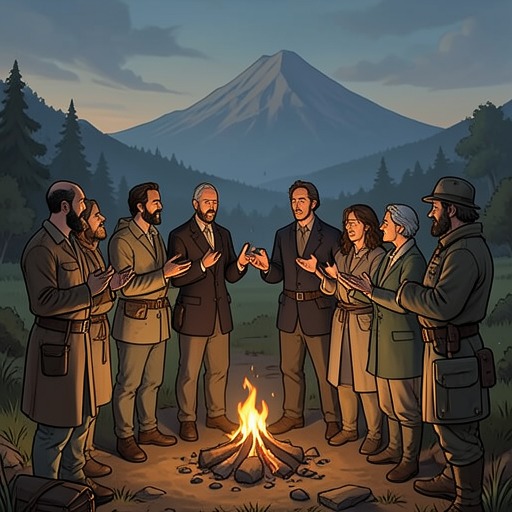
The pact is made under conditions of political danger. During the night, the assembled men acknowledge the humiliation of having to meet secretly on the soil their fathers left them, as if their gathering itself were criminal. The stage picture reinforces the tension: the meeting takes place in darkness, with the lake and glaciers visible in moonlight, and the men who gather include armed peasants. The secrecy is not presented as a rejection of their community’s customary practices. Stauffacher instead proposes that they hold the Diet according to ancient usages, insisting that the cause remains just even though the meeting must occur at night.
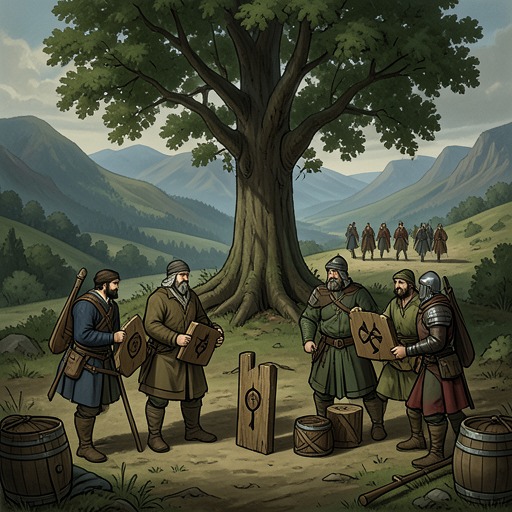
The gathering has a definite collective shape. Thirty-three men advance and take their places around a fire; later, Rosselmann calls for a ring to be formed and swords of power to be planted in the ground. The participants do not merely listen to a leader announce an alliance. They arrange themselves as a body, enter a shared ceremony, and make their agreement visible through joined hands. In the initial pledge, Stauffacher, Walter Furst, and Arnold of Melchthal clasp hands and extend their personal commitment to the three cantons: as the three men stand together, so will the cantons stand together in victory and defeat, in life and death.
Principles and Oath
The alliance’s central principle is solidarity without the erasure of local autonomy. Each canton is ruled by its own laws, but the speakers reject the idea that this makes them separate peoples. They invoke common ancestry and a common home, then turn that account of belonging into a promise of shared conduct. The declaration that they will act as one is therefore more than a statement of origin: it establishes a political obligation among communities that remain locally distinct.
The oath gives that obligation its strongest form. The men swear to be true brothers and never to part in danger or death; they also promise to trust in God and not to quail before the might of any man. The wording binds personal courage to collective endurance. Earlier, the three leaders had pledged themselves in both victory and defeat, so the alliance is not conditional on success. Its members commit to one another across the outcome of the struggle, making steadfastness—not an assured victory—the measure of fidelity.
The ceremony’s timing and deliberation also matter. Winkelried proposes waiting until Christmas, when serfs customarily throng to the castle, while another speaker reminds him that they all serve the same cause. The exchange shows that unity does not mean the absence of disagreement about when to act. Counsel calls for patience and for trust in circumstances, leaving something to the moment. By morning, the gathering has completed its oath; the men are told to go their separate ways. The scene presents coordination as a combination of firm common purpose and restraint about the precise opportunity for action, rather than as an immediate, fully specified plan.
Collective Action and Public Consequences
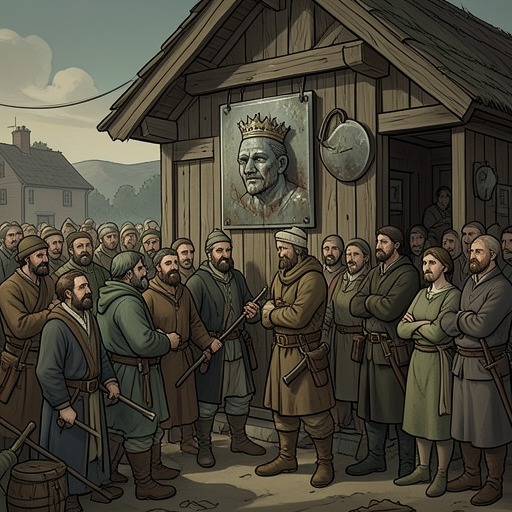
The alliance is associated with resistance that reaches beyond the secret assembly. The rumor of a recent atrocity has already spread through distant valleys, and the account describes it being carried from door to door. That circulation gives the confederacy a social setting wider than the men at the fire: reports of oppression move among communities, while the meeting provides a place where representatives can frame their response as a common cause. The play’s emphasis is on the connection between shared grievance and organized solidarity, not on an alliance maintained by a single commander.
Later scenes give the commitment a public consequence. When the country’s foe has fallen, the assembled voices declare that they will permit no further violence and that they are free men; the crowd answers that the country is free. The scene then expands: Arnold of Melchthal and Conrad Baumgarten enter amid the upheaval, with news that Sarnen lies fallen, and people fill the stage. The play does not make the final celebration a private reward for the original leaders. Freedom is spoken collectively, amid a population whose actions have become difficult to restrain.
The celebration also turns political change into a scene that can be remembered. Girls bring in a cap on a pole, and Furst observes that the children will remember the joyous occasion for the rest of their lives. The staged object and the children’s future memory connect the fall of coercive authority with the transmission of a shared public story. In this way, the Confederacy’s oath has an afterlife beyond the night meeting: an agreement first made in secrecy becomes part of a visible and memorable declaration that the country is free.
Narrative Significance
The Confederacy provides the play with a model of political agency based on mutual commitment. Individual acts and the efforts of named leaders remain part of the drama, but the oath insists that the cantons’ fate cannot be secured by isolated courage alone. The three leaders’ joined hands anticipate the larger circle of participants, and the circle’s promises lead toward the final gathering of a crowd. The movement is from a small sworn pledge to a public collective voice.
The alliance is also defined by the tension it refuses to resolve by choosing only one side: its members retain their own laws while claiming one common home and undertaking to act as one. That structure lets the play represent unity as cooperation among self-governing communities rather than submission to a new central authority. Its recurring terms—brotherhood, shared danger, and fidelity through defeat as well as victory—make the pact both a practical bond and an account of what holds the people together. The final cry of freedom gives that account its dramatic test: the promise of common action becomes meaningful when the country speaks in a common voice.